Dog-Eared and Defiant: How Book Lovers Became America's Unlikely Rebels
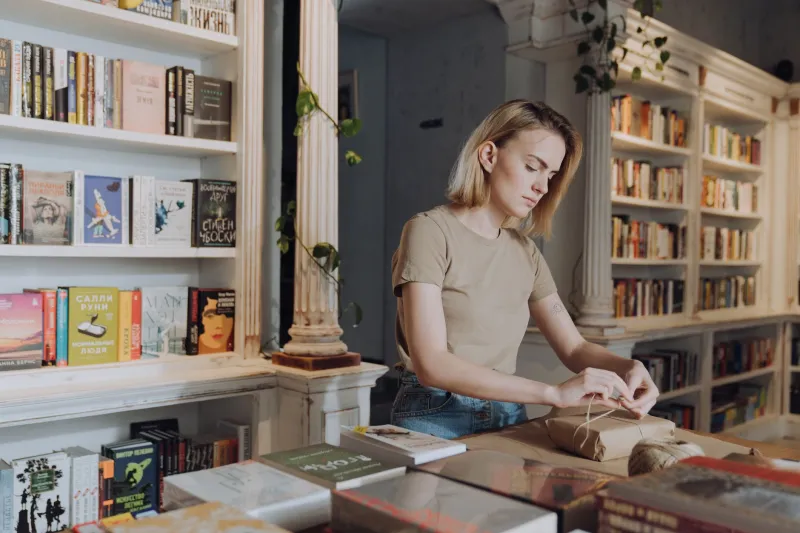
There's something almost radical about watching someone read a book in public these days. Not scrolling. Not listening to a podcast through one earbud. Actually reading — eyes tracking across a page, fingers turning paper, occasionally pausing to stare into the middle distance like they're chewing on an idea. It looks almost quaint. And somehow, that's exactly the point.
Across the US, a loose but growing movement of readers is treating deep, long-form literary consumption as something more than a hobby. For many of them, cracking open a 400-page novel or a dense work of narrative nonfiction is a conscious rejection of the algorithmic content machine — a small, personal act of intellectual defiance in a culture that increasingly rewards the fast, the frictionless, and the easily shareable.
Call them the new counterculture. They're carrying tote bags instead of guitars, but the spirit is surprisingly similar.
When Choosing a Book Feels Like a Political Statement
Marissa Calloway, a 29-year-old graphic designer in Austin, started what she calls her "analog hours" about two years ago — a deliberate, phone-free block of evening time dedicated entirely to reading. She didn't start a blog about it. She didn't post about it. That was kind of the whole point.
"I realized I was consuming content constantly but retaining almost nothing," she says. "Reading a novel felt like the opposite of that. It was slow, it demanded something from me, and honestly? That friction felt really good."
Her experience isn't isolated. Independent bookstores across the country — long assumed to be dying — have seen a remarkable resurgence. According to the American Booksellers Association, the number of indie bookstores in the US has grown steadily over the past decade, with hundreds of new storefronts opening even as retail broadly has struggled. Many owners describe their shops not just as retail spaces, but as community anchors for people hungry for something algorithms can't curate.
At a beloved independent shop in Portland, Oregon, the owner describes regulars who come in not necessarily knowing what they want, but knowing they want to search for it — to browse, to be surprised, to have a conversation with a bookseller who actually read the thing. "That experience just doesn't exist online," she says. "You can't replicate the serendipity."
Your Brain on Long-Form Narrative
Neuroscience is starting to back up what devoted readers have always suspected: deep reading does something genuinely different to the brain. Research from institutions including Emory University has shown that reading literary fiction activates neural pathways associated with empathy, perspective-taking, and complex emotional processing — areas that passive content consumption largely leaves dormant.
More provocatively, studies on attention suggest that the capacity for sustained focus — the kind required to follow a novel's plot across 300 pages — is effectively a trainable skill. And like any skill, it atrophies without use. Some cognitive scientists have started using the term "attentional fitness" to describe this capacity, and by that metric, habitual scrollers may be quietly losing ground.
Dr. Maryanne Wolf, a cognitive neuroscientist and author of Reader, Come Home, has written extensively about what she calls the "deep reading brain" — the complex network of cognitive processes that literary reading uniquely engages. Her concern is that we're trading a rich, hard-won mental capability for the quick dopamine loop of short-form content, often without realizing what we're giving up.
For a growing number of Americans, that framing has landed with real force. Reading isn't just entertainment anymore. It's maintenance.
The Literary Community as Creative Gathering Ground
What makes this movement particularly interesting isn't just the solitary act of reading — it's what's forming around it. Book clubs have always existed, but the new iteration looks different. They're less about polite discussion over wine and more about genuine intellectual sparring. They're popping up in breweries, community centers, and rented gallery spaces. Some are organized around specific themes — speculative fiction, translated literature, banned books — that carry an obvious cultural charge.
In cities like Chicago, Brooklyn, and Denver, literary events have started drawing crowds that look a lot like the indie music scenes of previous decades: young, creative, slightly suspicious of mainstream taste, and deeply invested in recommending things to each other. There's a social currency in having read the right book, in being the person who introduced a friend to an obscure novelist.
Independent publishers, too, are capitalizing on this energy. Small presses that specialize in challenging, unconventional work — the kind of thing that would never get a major marketing budget — are finding passionate audiences through word of mouth, Substack newsletters, and the kind of grassroots enthusiasm that no algorithm predicted.
Reading as Resistance, Not Nostalgia
It would be easy to frame all of this as nostalgia — a reactionary longing for a slower, pre-digital world. But that misses what's actually happening. The people leading this quiet literary rebellion aren't anti-technology in any sweeping sense. Most of them live online like everyone else. They use streaming services, they have social media accounts, they probably have strong opinions about their phone's notification settings.
What they're pushing back against is something more specific: the idea that all content is equivalent, that attention is just a resource to be harvested, that depth is inefficient. Choosing to read a challenging novel is, in this context, less about rejecting the present and more about asserting something about the kind of mind you want to have.
There's also something worth noting about the aesthetics of it. Book covers have become genuinely covetable objects. Literary tattoos are everywhere. "What are you reading?" has re-emerged as a legitimate opening line. The bookworm identity, once reliably nerdy, has acquired a kind of cool that feels earned rather than manufactured.
The Pulse of the Page
None of this means the novel is "back" in some triumphant, industry-saving way. Publishing still faces enormous structural challenges. Attention is still scarce. TikTok still wins the afternoon.
But something real is shifting in the cultural mood. A meaningful number of Americans — particularly younger ones — are starting to treat their attention as something worth protecting, and they're finding that books are one of the most satisfying ways to spend it. Not because reading is virtuous, exactly, but because it delivers something that the content feed genuinely cannot: the experience of being fully inside another world, for hours at a time, with no notification interrupting the spell.
In an attention economy built on fragmentation, that's not just a preference. It's a statement.
And somewhere in a coffee shop right now, someone is making it — dog-eared paperback in hand, phone face-down on the table, utterly unreachable.